
You're funding the wrong partnerships. Here's how to tell.
Import partners, customers and the delivery work between them. Day one shows what's missing and where to focus. As the data grows, it shows which relationships keep customers, and which just look busy.
Counting partners is easy. Knowing which ones keep customers is not.
Referrals leave a record: a deal, a date, a partner name. The partners who onboard your customers, help them adopt and make renewals easy mostly don’t, so their work never reaches the scorecard. The referral credit is real. The rest sits beside it, uncounted.
See what partners do after the saleFrom Part 3 of the Customer-First Ecosystem series, The Measurement Gap. The record stops where customer value starts.
A partner QBR, assessed from two perspectives.
We reviewed a typical partner QBR from the vendor's perspective and then from the customer's. The figures are the same in both. The questions are different, and one of them the deck can't answer. 72 seconds.
The firms and figures are fictional. There is no sound; the captions carry the story.
Start with a spreadsheet. The first two steps happen today.
Import what you have
CSV or Excel, with flexible mapping. Partners, customers and the delivery relationships between them.
See what you have
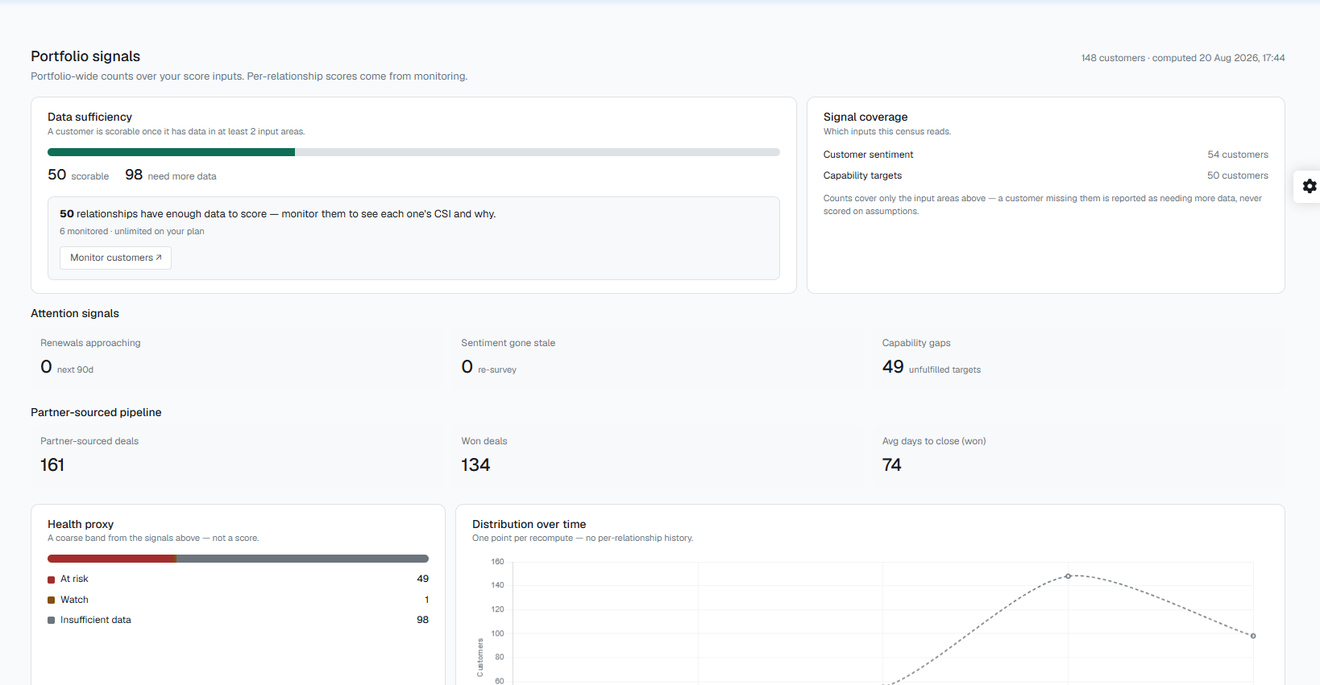
Counts, concentration, coverage gaps and data-poor relationships: your complete picture on day one.
Watch the picture fill in
Monitor the relationships that matter: health, sentiment, renewals and, in time, who produced each outcome.
Every score starts at the customer.
We measure at the customer and attribute across the ecosystem. A partner and a customer are scored by the same arithmetic; the only difference is what each of them did, and when. Four measures and one attribution layer, and when the data is too thin the score is withheld rather than guessed.
Values shown are illustrative; scoring is deterministic on every tier. Full definitions, inputs and withholding rules →
Most of what you know about your ecosystem is sitting in documents.
Upload agreements, certifications and partner rosters. Agents read them and pull out the organisations, relationships and capabilities, with a confidence score on every field. Nothing enters your workspace until you have approved it.
See a batch being processedOne record. Three people, in order.
Partnership leads
Where it starts. See where to invest: which relationships compound and which just look busy.
See how scoring worksCustomer success
Where it becomes true. Customer outcome data is what turns a partnership claim into a measured one — and flags which accounts need attention while there is still time to act.
Read the customer-first casePartners themselves
Where it stays current. Unlimited free portal seats, so partners maintain their own record instead of you chasing it.
See the portalFree for 5 monitored relationships.
A monitored relationship is one Entwine scores continuously. Users, portal seats and the registry are unlimited and free. Paid tiers from $99/mo when you want more than five scored.
FAQ
Questions we get asked.
Is this a PRM?
No. PRMs manage partner pipeline; Entwine connects partnerships to customer outcomes. It complements a PRM or CRM rather than replacing one.
What do I need to start?
A CSV. No integrations are required on the Free tier: import your partner list and Entwine shows you what you have.
Is the free tier really free?
Yes: no card, no seat charges, no portal caps. Free for 5 monitored relationships.
What happens when all 5 monitored slots are used?
Nothing is lost. Your registry keeps growing; scoring simply pauses for additional relationships until you free a slot or upgrade.
Where is my data?
Hosted on DigitalOcean in the US (New York), with fail-closed tenant isolation. Entwine Limited is a UK company; for UK and EU customers the US hosting is covered by a data processing agreement on the standard contractual clauses with the UK addendum (currently in counsel review; draft available from privacy@entwineapp.io). See the security page for the full picture.